 Pest Control Services
You had the treatment done. The visible roaches disappeared for a while, maybe even a few weeks. Then one night you flip on the kitchen light and there they are again, scattering back into the cracks like nothing happened. Frustrating. Confusing too, since it feels like the treatment should've just worked.
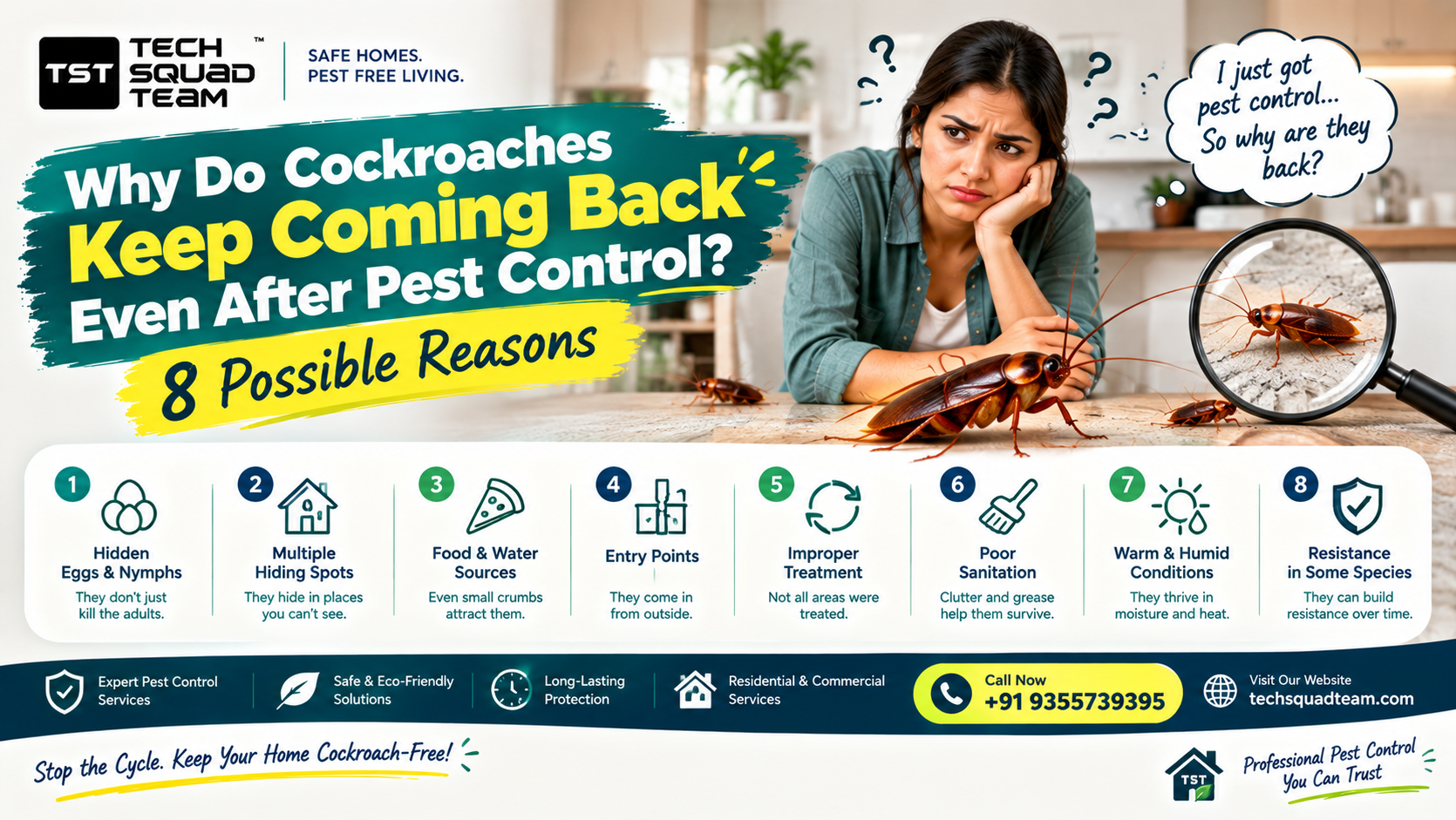
Here's the thing though. In a lot of cases, it did work, on the roaches it actually reached. The reason they're back usually comes down to cockroach biology being genuinely built to survive exactly this kind of pressure, more than the treatment itself falling short. Eight reasons below, starting with the one people misunderstand the most.
A female German cockroach carries her egg capsule, called an ootheca, right up until it's nearly ready to hatch, and each one can hold around 30 to 40 eggs. Say a spray or bait kills every adult roach in sight, but the ootheca was tucked away somewhere the treatment never reached, or got dropped and left intact somewhere. Those eggs hatch on their own timeline regardless. A few weeks later, you've technically got a "new" infestation from roaches that were never actually killed off in the first place. The life cycle didn't restart. It just kept going the whole time.
Cockroaches are genuinely, almost impressively good at finding places humans can't easily access. Wall voids. Behind kitchen cabinetry. Inside electrical conduits. Under the rubber gasket of a refrigerator, of all places. A technician working purely from visible activity can miss these harborage points entirely, especially without a proper inspection first. Treatment that only covers what's visible tends to leave a whole population intact somewhere just out of sight.
Cockroach populations exposed repeatedly to the same active ingredient over time can develop genuine physiological resistance. The chemical itself becomes less effective against that specific population. Nothing to do with faulty application, everything to do with the roaches surviving each round passing on genes that make the next generation harder to kill. This is a documented, ongoing challenge across pest management, not some fringe theory somebody made up.
This one genuinely surprised me when I first read into it, and honestly it's one of the more interesting things happening in pest science right now. Since the 1990s, researchers have documented German cockroach populations that evolved an aversion to glucose, the sugar historically used to make bait appealing. Their sense of taste literally rewired glucose to register as bitter instead of sweet, so they just avoid glucose-based bait entirely. A bait that would've worked perfectly a decade ago can flat out fail against a population carrying this trait, and most bait packaging doesn't even tell you whether glucose is in the formula.
Roaches can go roughly a month without food and around a week without water, depending on species and conditions. That kind of endurance means a population under pressure doesn't need to touch treated bait right away. Some individuals just wait it out in a low-activity state until conditions look safe again, then resurface once things have calmed down. Patient little survivors, in a grim sort of way.
In apartments, row houses, or any densely built structure, cockroaches travel through shared plumbing chases, drain lines, and wall cavities between units. Your home can be fully, properly treated and still pick up new roaches migrating in from a neighboring unit that hasn't been treated at all. Especially common in older buildings, or anywhere adjoining units share utility lines.
Chemical treatment kills roaches. That's it, that's what it does. It doesn't fix a leaking pipe under the sink, clear out cluttered storage that gives them cover, or seal a gap behind the stove. Food, moisture, hiding spots, if all three are still available after treatment, the environment's still telling any surviving or migrating roaches this is a good place to move in. Treatment without addressing those conditions tends to buy time more than solve the actual problem.
Given everything above, egg cycles, resistance, hidden harborage, a single treatment is often just the first step, not the whole job. Most professional pest management plans build in follow-up visits specifically to catch newly hatched roaches and anything that survived round one before it re-establishes. Skipping that follow-up, or assuming one visit should permanently solve things, is one of the more common reasons people feel like treatment "didn't work" when really it just wasn't finished yet.
None of this means treatment's pointless. Quite the opposite, honestly. It means the effective approach looks less like a single spray and more like a structured plan: a real inspection to find harborage points, a bait or treatment strategy that accounts for resistance where it's relevant, sealing entry points and fixing moisture issues, and a scheduled follow-up instead of a one-and-done visit. For a deeper look at how Bangalore's specific climate and building conditions factor into recurring infestations beyond cockroaches, our guide on why pests keep coming back after treatment covers that ground in more depth.

TechSquadTeam Ground Floor, Plot No 118 Neil Rao Towers, Road No 3, EPIP Phase 1, Whitefield Road

Leave A Comment
Your email address will not be published. Required fields are marked *