 Cleaning Services
We get that call more than you'd think. Someone calls, a little peeved, that the cleaning crew “missed spots.” Grease behind the stove. The ceiling fan blades were coated with dust. And nine times out of 10, when our team walks through what really happened, it turns out nobody was cutting corners. The home was getting a regular clean when what it really needed was a deep clean. These are two different jobs and are normally booked as if they are the same. It is probably the number one reason why people end up disappointed with a cleaning service.
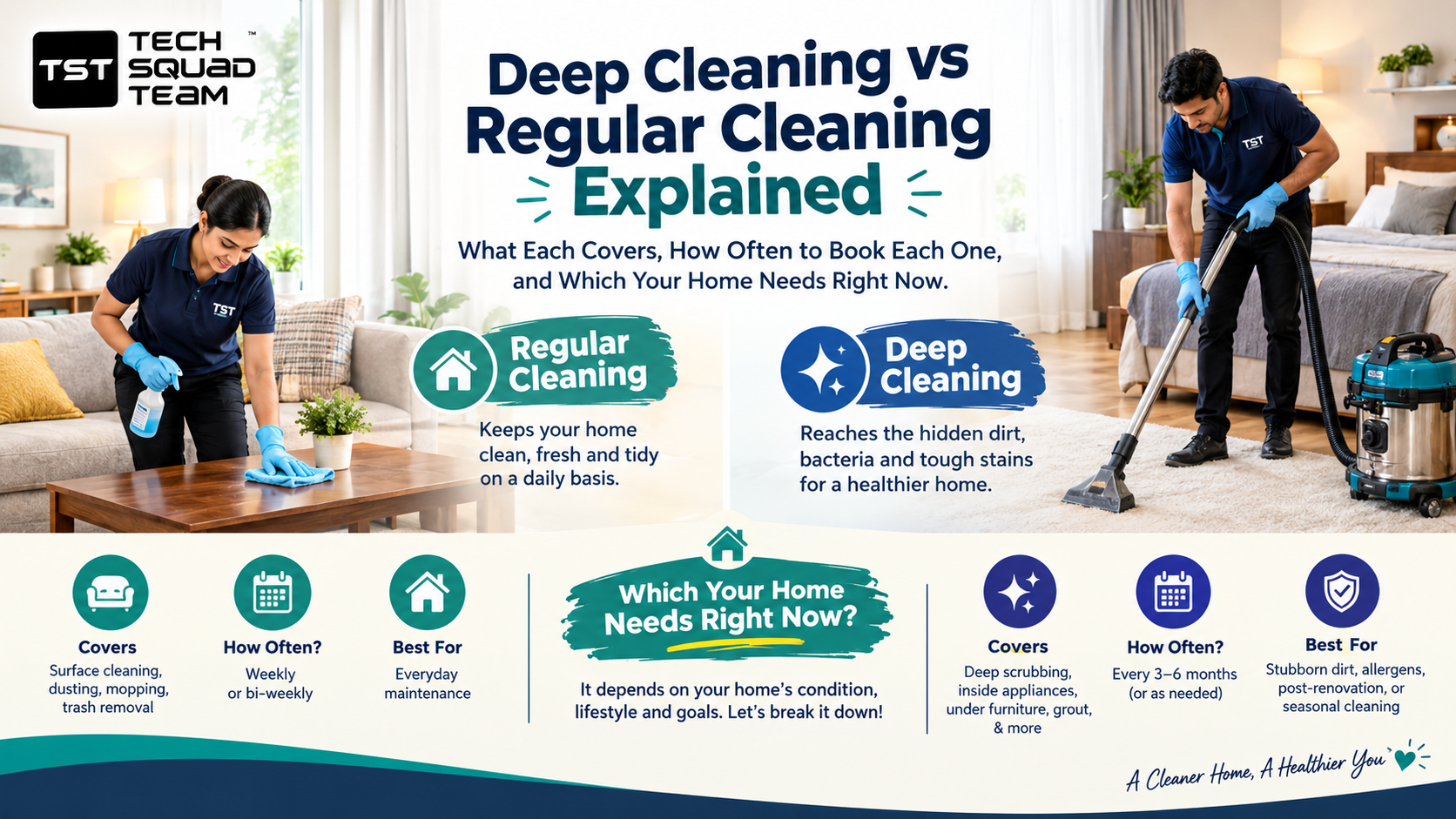
Think of regular cleaning as upkeep. It keeps a home that's already in decent shape from sliding backward. Deep cleaning is more of a reset button, the kind of clean that tackles months of build-up in places no one thinks about on a daily basis: grout lines, behind the fridge, ceiling corners, back of cabinets
Put simply, a recurring clean maintains a baseline that already exists. A deep clean is what creates that baseline in the first place, a distinction Effective pest control draws the same way. But if the last professional clean was a while ago (or you've never had one) then a regular visit just means the cleaner spends the entire visit working around problems that the service was never meant to deal with.
Regular cleaning, sometimes called maintenance or standard cleaning, covers the stuff most households would otherwise be doing themselves, just done faster and more consistently. It's built for homes on a weekly, biweekly, or monthly rhythm, not for occasional deep intervention.
Typical scope:
Sweeping and mopping floors
Dusting furniture and easily accessible surfaces
Vacuuming carpets and rugs
Wiping kitchen counters and the exterior of appliances
Cleaning and disinfecting bathroom surfaces
Making beds, emptying trash, spot-cleaning mirrors
For a typical three-bedroom home, this runs about 1.5 to 3 hours. That's short by design. The crew's maintaining a baseline that's already clean, not fighting years of buildup.
Deep cleaning covers everything in a regular clean, then goes further into the spots routine visits skip on purpose, since they don't need weekly attention. Baseboards, blinds, vents, inside the oven and fridge, grout lines, the space behind furniture. All of it.
Typical scope, on top of the regular list:
Scrubbing grout, tile joints, and stubborn bathroom buildup
Cleaning inside the oven, refrigerator, and cabinets
Washing window frames and tracks, not just the glass
Dusting ceiling fans, light fixtures, and vents
Deep cleaning carpets, upholstery, and mattresses
Wiping down baseboards and skirting
For that same three-bedroom home, expect two to three times the duration of a regular clean. The crew's dealing with real accumulated grime, not a light layer of dust. And honestly, that's the whole reason it costs more too. You're paying for the extra hours and labor, not some markup for an "equivalent" service dressed up fancier.
A few situations where deep cleaning makes more sense:
It's been three months or more since a professional clean. A regular visit just can't catch up on that much backlog in one go.
You're moving in or out. Landlords and incoming tenants usually expect appliances, cabinets, and fixtures cleaned well beyond routine standards, and this often matters for getting your deposit back.
You're starting a recurring service for the first time. Most cleaning pros recommend an initial deep clean so every visit after that actually maintains a clean home instead of slowly falling behind.
You're noticing dust on baseboards, blinds, or vents, or grease building up in the kitchen. These are the visible signs your home's moved past what a standard clean can fix.
The home just went through construction or renovation. Fine dust from drilling and cutting settles into places a regular clean simply won't reach.
If none of that applies and you just want to keep an already-clean home looking that way, regular cleaning is the more sensible, cheaper call.
Technically, sure. Would we recommend it? Not really. We've had clients try this, book deep cleaning every visit just to be safe, and end up paying deep-clean rates (1.5 to 2 times a regular visit) for work that didn't need that level of effort. It's the cleaning equivalent of servicing your car every week because you're worried about the engine.
Most professionals suggest one deep clean to reset things, then regular cleaning on a recurring schedule to keep it that way. Most homes need a full deep clean again every three to six months, sooner if you've got pets, kids, or allergies in the house, since dust and pet dander build up faster under those conditions.
Worth noting: this isn't just about how the place looks. Cleaning on a consistent schedule measurably cuts down indoor dust and allergens, dust mites and pet dander included, which matters a lot if anyone in the house deals with allergies or asthma.
|
Feature |
Regular Cleaning |
Deep Cleaning |
|
Goal |
Maintain an already-clean home |
Reset a home with built-up grime |
|
Frequency |
Weekly, biweekly, or monthly |
Every 3–6 months |
|
Time (3BHK) |
1.5–3 hours |
3–6 hours |
|
Cost |
Base rate |
1.5–2x the regular rate |
|
Best for |
Ongoing upkeep |
Move-in/move-out, first-time booking, long gaps since last clean |
If your home's already on a regular schedule and mostly just needs upkeep, regular home cleaning is the right call, with a deep clean saved for once or twice a year. If it's been months since the last professional visit, you're mid-move, or the home's never been professionally cleaned at all, a deep home cleaning is the better starting point. Paying maintenance rates for a job that needs a full reset just doesn't add up. Either way, confirm the exact scope of the quote before booking. Checklists vary a lot between providers, and that gap is usually where expectations and delivery part ways, which is exactly the call we opened with.
Moving into an unfurnished space, or handing back a rental? An empty home cleaning covers ground a standard deep clean might not, since there's no furniture in the way of full access to skirting, cabinet interiors, and corners.

TechSquadTeam Ground Floor, Plot No 118 Neil Rao Towers, Road No 3, EPIP Phase 1, Whitefield Road

Leave A Comment
Your email address will not be published. Required fields are marked *