 AC Services
Booked an "AC service" expecting a full checkup, but the technician just swapped one part and left? Or called for a repair and got handed a maintenance pitch instead? Happens all the time, and honestly it costs people money both ways, either paying for a repair when a service call would've caught the issue early, or paying for a "service" when the unit's already broken and needs an actual fix, not a checklist. Here's how to actually tell which one your AC needs.
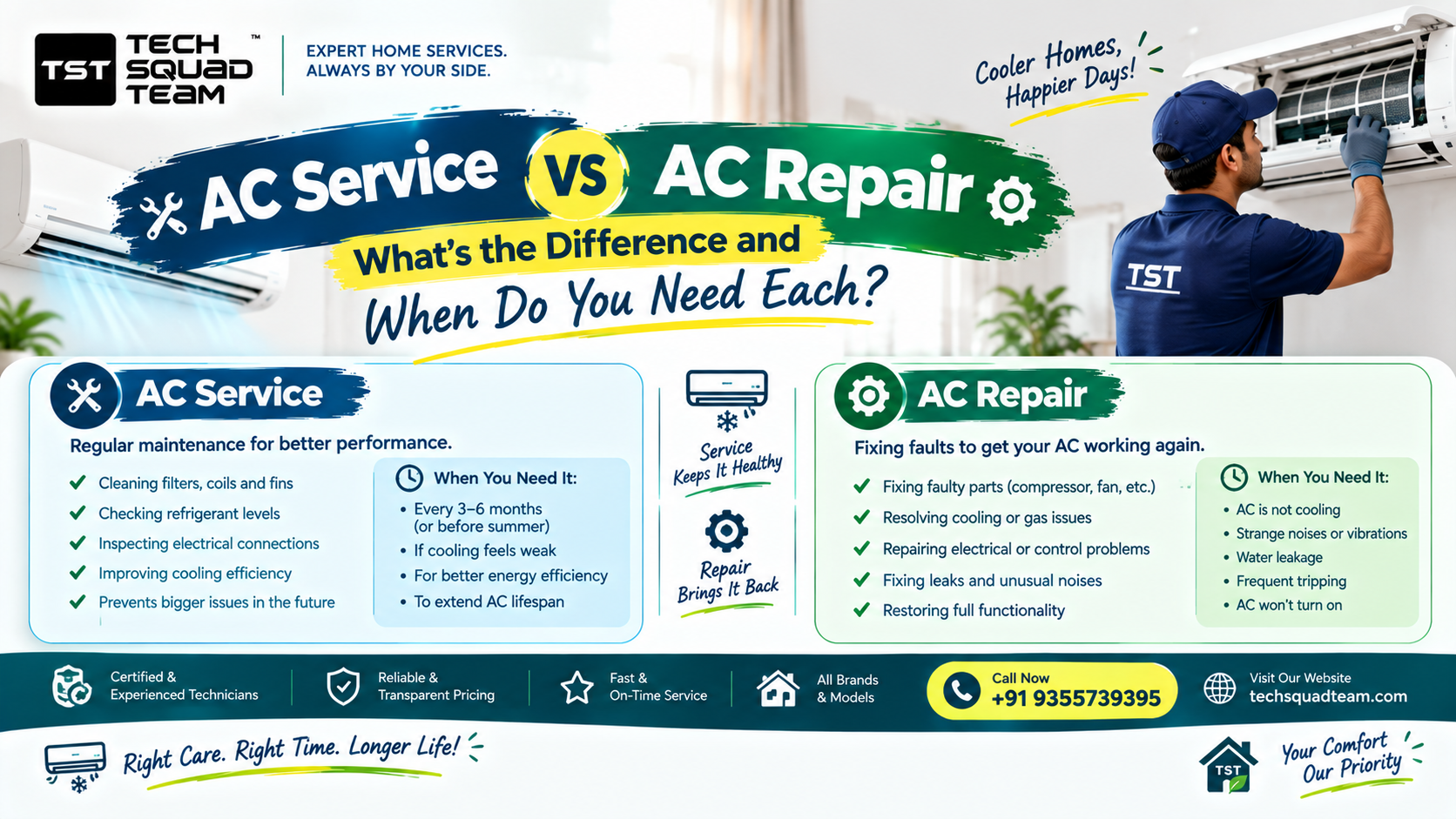
AC service is preventive. You book it when the unit's still running fine and you just want to keep it that way. AC repair is reactive, you book it when something's already gone wrong, the AC isn't cooling properly, won't turn on, or is making a noise it definitely shouldn't be making.
Think of it like a car, honestly the comparison holds up better than most. Service is the oil change and tune-up you do on an engine that's still running fine. Repair is what happens after something's actually broken and the car won't start. Mix the two up and you usually end up in one of two spots, either skipping service until something breaks that a ₹500 filter clean would've prevented, or calling for a "service" when what you actually need is someone diagnosing a specific fault.
AC service, sometimes called maintenance or a seasonal tune-up, is routine care done on a unit that's still cooling just fine. Nothing's getting fixed here, the point is keeping the system efficient and catching small problems before they turn into the expensive kind.
A typical AC service visit covers:
Cleaning or replacing the air filter
Cleaning the indoor and outdoor coils
Checking refrigerant levels and topping up if needed
Inspecting electrical connections and tightening loose ones
Clearing the condensate drain line
Checking airflow and overall cooling performance
Most technicians recommend this once or twice a year, usually before summer and again partway through the season if the unit's running heavily. Cost tends to be low and predictable, since it's a fixed checklist rather than chasing down some unknown problem.
AC repair is corrective work, done after a specific fault's already shown up. No fixed checklist here either, a repair visit starts with actual diagnosis, figuring out exactly what's failed, then fixing or replacing that part.
Common reasons for an AC repair call:
The unit isn't cooling at all, or cooling way less than it used to
Strange noises, grinding, buzzing, rattling, coming from the indoor or outdoor unit
Water leaking or pooling near the indoor unit
Ice forming on the outdoor coil
The unit won't turn on, or shuts off partway through a cycle
A sudden, unexplained jump in the electricity bill
Repairs swing wildly in cost and complexity. Some are quick, replacing a capacitor, done in twenty minutes. Others involve a failed compressor or major component, which eats up more time and money. Unlike service, there's genuinely no fixed price until a technician's actually looked at what's wrong.
If the AC's running and cooling normally, and it's just been a while since the last checkup, that's a service call, plain and simple. If something's actively wrong, no cooling, a strange noise, water where there shouldn't be any, the unit refusing to start, that's a repair call, and it usually shouldn't sit on your to-do list too long.
A few situations sit in a grayer zone. A slow decline in cooling over a few weeks could go either way, sometimes it's just a filter or coil that needs cleaning, something a service visit handles fine, and sometimes it's a slow refrigerant leak that actually needs a repair. If you genuinely can't tell which camp you're in, booking a service first is a reasonable call, since the inspection itself usually reveals whether something needs repairing too.
According to ENERGY STAR and the U.S. Department of Energy, a dirty air filter alone can push up an air conditioner's energy consumption by 5 to 15 percent, since restricted airflow forces the system to work harder and lets dirt reach the evaporator coil. That's not just a bigger electricity bill sitting there quietly, it's added strain on components that eventually leads to exactly the kind of failure that needs a repair call instead of a routine one.
This is really the whole argument for bothering with regular AC service in the first place: cheaper and way more predictable than repair, and honestly, a good chunk of the failures that trigger a repair call trace right back to something a routine service visit would've caught months earlier, a dirty filter, a clogged drain, low refrigerant, long before any of it turned into an emergency.
|
Factor |
AC Service |
AC Repair |
|
When to book |
Unit is working, routine upkeep |
Unit is malfunctioning or not cooling |
|
Frequency |
1–2 times a year |
As issues come up |
|
Cost |
Low, predictable, fixed checklist |
Varies widely by fault |
|
Goal |
Prevent problems, maintain efficiency |
Diagnose and fix a specific failure |
|
Urgency |
Can be scheduled in advance |
Often needs prompt attention |
If your AC's cooling just fine and it's been a while since anyone's looked at it, book AC service and get ahead of the problem instead of waiting for one to show up on its own. If something's actively wrong, no cooling, strange sounds, water leaking, the unit won't turn on, skip straight to AC repair rather than booking a routine visit that isn't going to diagnose the actual fault anyway. Either way, mention exactly what you're noticing when you book, even the small stuff, it helps the technician show up prepared instead of guessing on-site. If cooling's just gradually gotten weaker with nothing obviously broken, booking a service visit first is a reasonable move, since the inspection itself usually reveals whether a repair's actually needed.

TechSquadTeam Ground Floor, Plot No 118 Neil Rao Towers, Road No 3, EPIP Phase 1, Whitefield Road

Leave A Comment
Your email address will not be published. Required fields are marked *