 Cleaning Services
Keeping a home clean can feel like a never-ending task. Between cooking, working, children, guests, dust, spills, and everyday clutter, household cleaning can quickly consume your time. The solution is not necessarily to clean for longer - it is to clean more systematically.
The best professional home cleaning tips focus on working in the right order, using the right method for each surface, preventing dirt from spreading, and giving extra attention to areas that are easily overlooked.
Whether you live in an apartment, independent house, or large family home in India, these practical methods can make regular home cleaning easier while helping you maintain better home hygiene.
One of the simplest professional home cleaning tips is to remove clutter before reaching for the cleaning products.
Loose clothes, toys, newspapers, dishes, chargers, and other objects make surfaces harder to clean and slow you down.
Start with a quick five- to ten-minute reset:
Why it works: You can clean the actual surface instead of repeatedly lifting and moving objects.
For example, clearing a dining table first makes wiping it a one-minute job rather than a ten-minute exercise.
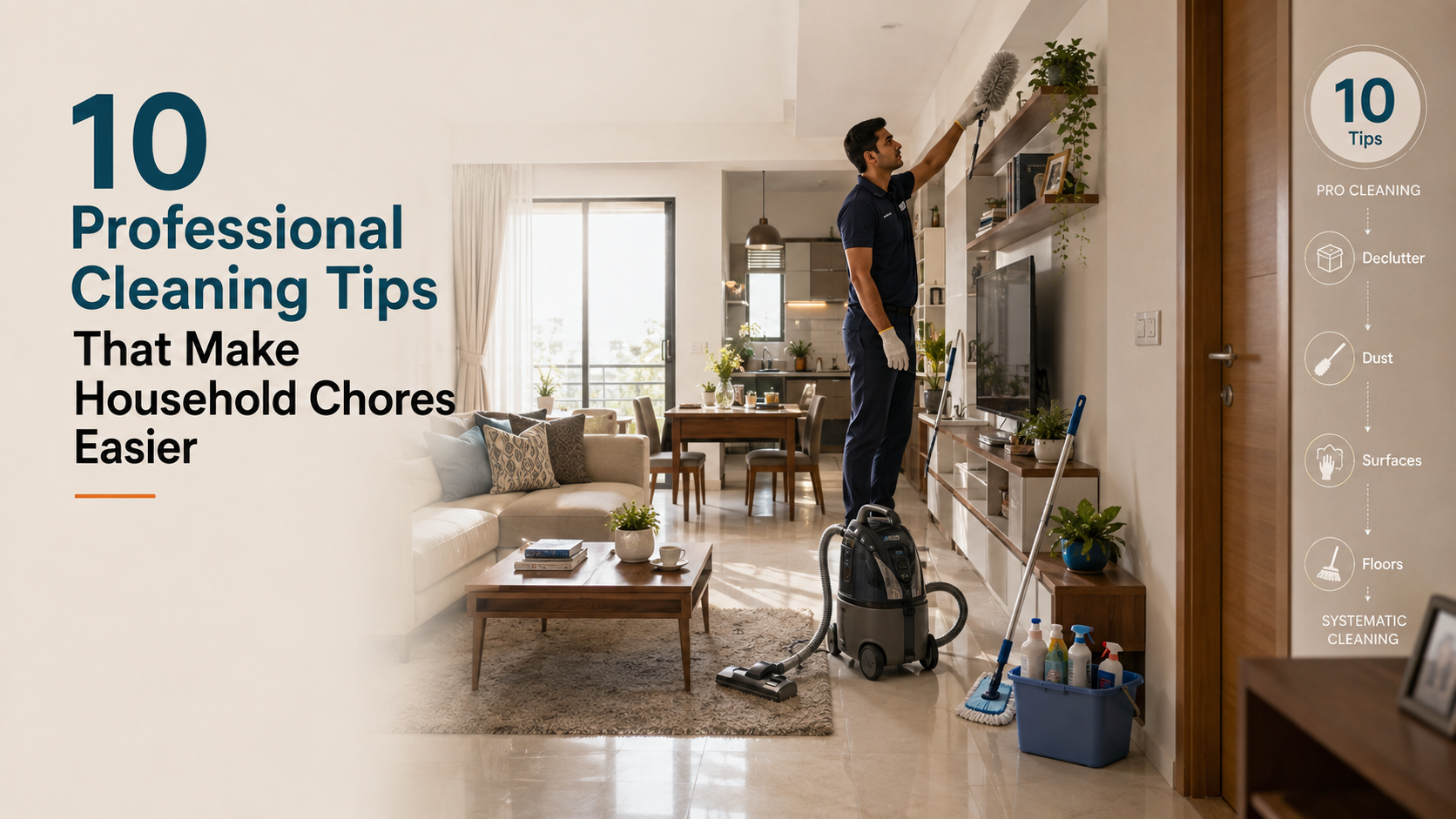
Always work from higher surfaces toward lower surfaces.
Dust from shelves, ceiling fans, cupboards, and other elevated surfaces can fall onto areas below. If you mop the floor first and then dust the ceiling fan, you may have to clean the floor again.
A useful sequence is:
Ceiling/fans → shelves → furniture → countertops → lower surfaces → floor
This simple order is one of the most effective house cleaning tips because it reduces duplicated work.
Another professional technique is to avoid transferring dirt from heavily soiled areas to relatively clean ones.
For example, when cleaning a kitchen:
Use separate clothes or cleaning tools where appropriate, particularly for kitchen and bathroom tasks.
Why it matters: A cleaning routine should remove contamination—not spread it around the house.
Instead of randomly moving around the house, divide cleaning into zones.
For example:
Bedroom: Make the bed → dust surfaces → clean mirrors → vacuum/sweep → mop if appropriate.
Living room: Declutter → dust → clean frequently touched surfaces → vacuum upholstery/floor → mop.
Kitchen: Clear counters → clean appliances and worktops → clean sink → clean floor.
Bathroom: Clear products → clean basin and fixtures → clean shower area → toilet → floor.
A room-by-room system gives you a clear finish line. It also makes it easier to divide household chores among family members.
More cleaning products does not necessarily mean better cleaning.
Use products and tools that are appropriate for the material. Follow the manufacturer's instructions for surfaces and appliances, particularly for electronics, natural stone, wood, painted finishes, and specialised materials.
A basic household cleaning kit can include:
Professional insight: The cleaning method often matters as much as the product. Wiping or scrubbing physically removes dirt, while a chemical product may have a specific purpose such as disinfecting.
Some surfaces are handled constantly but may not look dirty.
Think about:
Clean these surfaces regularly, particularly after visitors or when someone in the household is sick.
However, always check the manufacturer's instructions for electronics and other sensitive items before applying a cleaning product.
Regular cleaning maintains the home day to day or week to week. Deep cleaning focuses on accumulated dirt and areas that routine cleaning may not reach thoroughly.
For example, regular cleaning might include:
Deep cleaning may involve more detailed attention to:
There is no universal schedule that fits every household. A practical frequency depends on household size, children or pets, dust levels, lifestyle, seasonal conditions, and how consistently routine cleaning is performed.
Instead of following an arbitrary calendar, inspect the home. If dirt is accumulating in areas that routine cleaning is not addressing effectively, it may be time for a deeper clean.
Small problems are usually easier to handle before they become large ones.
Clean food spills, water around bathroom fixtures, kitchen splashes, and visible dirt as soon as practical and according to the surface requirements.
This is especially useful in Indian kitchens, where oil, spices, food particles, and cooking residue can accumulate around frequently used areas.
A quick wipe after cooking can prevent a small amount of residue from becoming a stubborn cleaning job later.
Cleaning faster is never worth compromising safety.
Always:
Most importantly, never mix bleach with other cleaning chemicals. Such combinations can produce hazardous vapours.
If using a disinfectant, follow its required contact time—the period the surface must remain appropriately wet for the product to work as directed.
Good home cleaning does not mean doing everything yourself.
Some situations require more time, equipment, experience, or physical effort than routine household cleaning allows.
Consider specialist help when:
Professional cleaning can be particularly useful when the goal is to reset the condition of the home, after which regular maintenance becomes easier.
|
Regular Home Cleaning |
Deep Home Cleaning |
|
Maintains everyday cleanliness |
Targets accumulated or difficult-to-reach dirt |
|
Usually performed frequently |
Performed periodically or when needed |
|
Focuses on routine surfaces |
Covers more detailed areas |
|
Suitable for ongoing maintenance |
Useful for a whole-home reset |
|
Usually manageable with household tools |
May benefit from specialist equipment and expertise |
Even a well-intentioned cleaning routine can become inefficient if you:
The goal of professional-style cleaning is not to make every chore complicated. It is to create a repeatable system that reduces wasted effort.
If routine cleaning is no longer keeping up with the condition of your home, specialist help can save considerable time and effort.
For example, a home that has not received detailed cleaning for an extended period may require more than ordinary sweeping, dusting, and mopping. A professional service can be useful when you need a thorough reset rather than another round of routine maintenance.
Use this guide first. When specialist help is appropriate, explore TechSquadTeam's Deep Home Cleaning service.
The easiest way to maintain a cleaner home is to work systematically rather than simply work harder. Declutter first, clean from top to bottom, move from cleaner to dirtier areas, use surface-appropriate products, pay attention to high-touch areas, and distinguish everyday maintenance from deep cleaning.
Most importantly, make safety part of the routine. Follow product instructions, ventilate when required, and never mix cleaning chemicals.
With the right system, household chores become more predictable, efficient, and manageable—and maintaining better home hygiene becomes part of everyday life rather than an exhausting occasional task.
Professional home cleaning tips are practical methods that make cleaning more systematic and efficient. They include decluttering first, cleaning from top to bottom, working from cleaner areas to dirtier ones, using the right tools for each surface, and maintaining a regular cleaning routine.
You can make household cleaning easier by following a consistent room-by-room routine, keeping cleaning supplies organised, dealing with spills promptly, decluttering regularly, and cleaning high-touch and frequently used areas routinely. Breaking larger cleaning tasks into smaller sessions can also make chores more manageable.
There is no single deep-cleaning schedule suitable for every household. The ideal frequency depends on factors such as household size, children or pets, dust levels, lifestyle, and how regularly routine cleaning is performed. A deeper clean is useful when dirt has accumulated in areas that regular cleaning does not adequately address.
Regular cleaning focuses on maintaining everyday cleanliness through tasks such as dusting, sweeping, mopping, and routine bathroom and kitchen cleaning. Deep cleaning is more detailed and targets accumulated dirt and less frequently cleaned or hard-to-reach areas.
Consider professional cleaning when your home needs a thorough reset, difficult-to-clean areas have accumulated significant dirt or grime, you are moving into or out of a property, or you do not have enough time or equipment for a detailed clean. Professional help can be especially useful when routine cleaning is no longer sufficient.

TechSquadTeam Ground Floor, Plot No 118 Neil Rao Towers, Road No 3, EPIP Phase 1, Whitefield Road

Leave A Comment
Your email address will not be published. Required fields are marked *