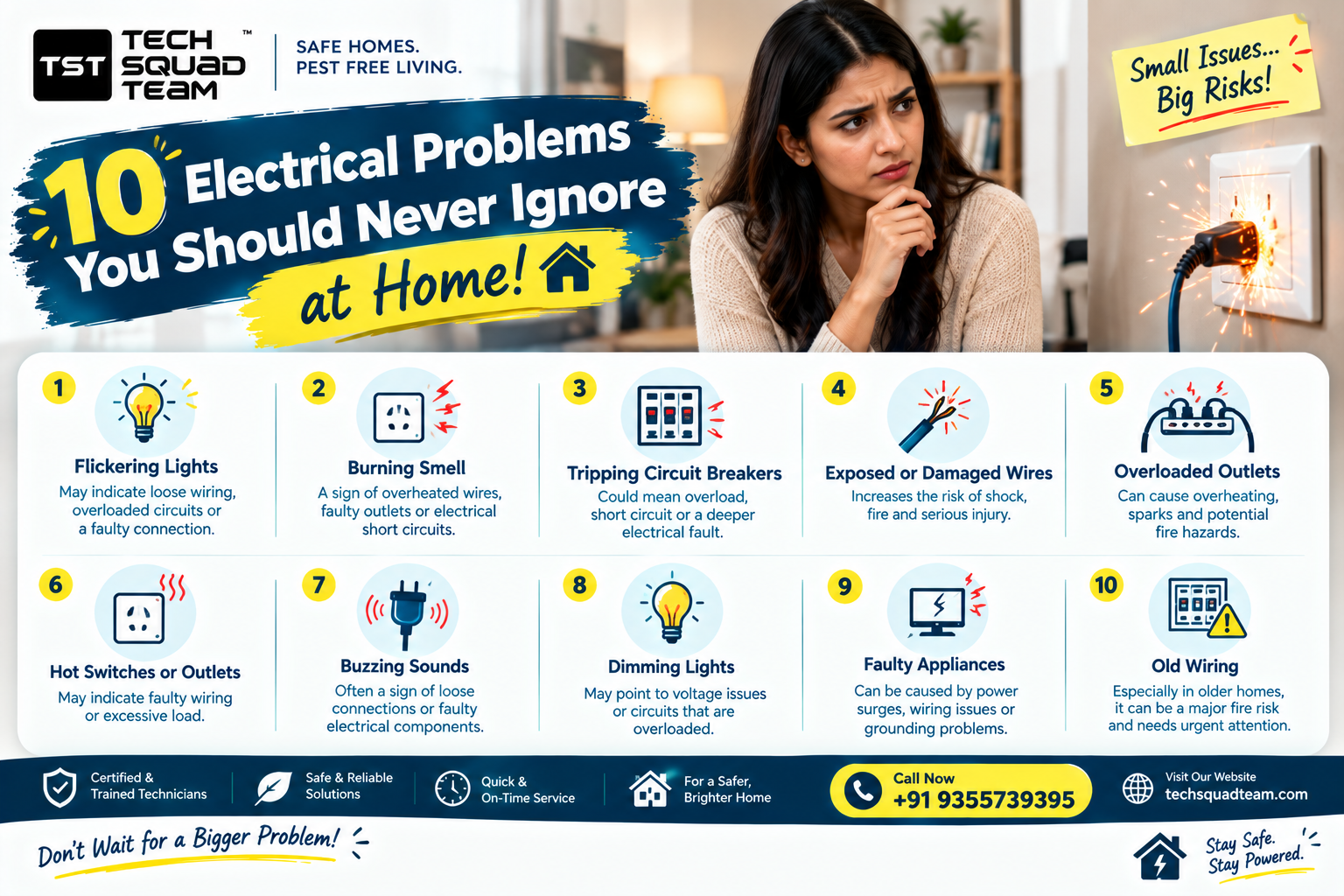
A breaker that trips twice a week. A switch that's warm to the touch. Lights that flicker just a little when the fridge kicks on. Easy to brush all of it off, honestly, since the lights still work and nothing's actually stopped functioning yet. That's kind of the problem though. Electrical failures cause an estimated 51,000 home fires a year, according to the Electrical Safety Foundation International (ESFI), and most of them show warning signs for weeks or months before anything actually catches fire. Here are the ten signs that genuinely mean it's time to call an electrician, not wait around and see what happens.
A breaker's got one job, cut power before a circuit overheats. If it's tripping over and over, ESFI notes that's usually one of two things, either too many appliances pulling power off one circuit, or a short circuit hiding somewhere in the wiring or an appliance itself. Either way, the breaker's doing exactly what it's built to do, which, if anything, makes it a strange thing to feel annoyed at rather than a reason to ignore what it's telling you.
What to do: Don't just keep resetting it and carrying on with your day. Repeated tripping on the same circuit means an electrician needs to figure out why, whether that's rebalancing the load across circuits or actually tracking down a fault somewhere in the wiring.
A little flicker when a heavy appliance kicks on can be totally normal in some homes. Flickering that happens a lot, spreads across multiple rooms, or shows up with no obvious appliance involved, that's a different animal. ESFI actually lists flickering or dimming lights specifically as a sign of a serious wiring problem, not just a lightbulb that's on its way out.
What to do: If it's just one lamp, try a new bulb first, cheapest fix there is. If it's happening across the house or keeps coming back after that, it's pointing at something upstream in the wiring or panel, and that's genuinely an electrician's call to make, not a guess you take yourself.
An outlet or switch plate should never feel warm to the touch, full stop. Warmth usually means current's arcing somewhere or resistance is building up behind the wall, both of which generate heat in a spot that's supposed to stay cool no matter what.
What to do: Stop using that outlet right away. An outlet can keep technically working while something unsafe is brewing behind it, so "it still charges my phone fine" really isn't a reason to leave it be. Get it checked before anyone plugs anything into it again.
A burning smell you can't trace back to a candle, cooking, or anything you can actually see is one of the more urgent signs on this whole list. Often it means the problem's sitting inside a wall, behind an outlet cover, or at the panel itself, none of which you're going to spot just by looking around the room.
What to do: If it's safe to do, cut power to wherever the smell's strongest and call an electrician right away. Don't sit around waiting to see if it gets worse or just fades on its own, it might not.
A small static shock now and then is one thing, everyone's felt that. A tingle or mild shock every single time you touch a specific switch, appliance, or metal fixture is a completely different situation, and it's a sign current's going somewhere it really shouldn't be.
What to do: Stop using that specific switch or appliance and get it looked at. This is also exactly the kind of fault a ground fault circuit interrupter, a GFCI, is built to catch, so if that outlet isn't GFCI-protected, that's worth asking your electrician about too while they're there.
A small spark when you plug something in every once in a while can happen and isn't automatically cause for panic. Repeated sparking, or a spark that just seems bigger than it should be, points to a loose connection or damage inside the outlet itself.
What to do: Stop using that outlet and get it inspected. Sparking that keeps showing up in the same spot means the fault's getting worse over time, definitely not resolving itself.
Electrical stuff should be silent, basically always. A buzzing, crackling, or humming sound coming from an outlet, switch, or the panel itself usually points to a loose connection or a wire under stress, both of which generate exactly the kind of friction that leads to heat and, eventually, fire.
What to do: Don't just assume it'll quiet down on its own. Have an electrician trace the sound back to its source, since by the time you can actually hear it, something's already not making proper contact somewhere.
An extension cord snaking across the room to power something that's basically permanent isn't only a tripping hazard, it's usually telling you the room doesn't have enough dedicated outlets or circuits for what's actually plugged in day to day. NFPA and ESFI specifically recommend having a qualified electrician add outlets instead of leaning on extension cords as a long-term fix.
What to do: If any single extension cord has quietly become a permanent fixture in your home rather than a temporary stopgap, mention it to an electrician. The real fix is usually adding a proper outlet, not hunting down a sturdier cord.
Yellowing, browning, or actual scorch marks around an outlet or switch plate mean heat's already been generated there at some point, whether anyone noticed it happening or not. This one's evidence of something that already happened, worth taking more seriously than a risk that merely might happen someday.
What to do: Treat it as urgent, not cosmetic, even if it just looks like discoloration you could paint over. A discolored cover means whatever's behind it got hot enough to leave a mark, and that same fault's very likely still sitting there.
Homes with original wiring that's decades old, or that have simply never had an electrical inspection, tend to have hidden issues even when nothing's obviously wrong yet. ESFI points out that a lot of the warning signs on this list only show up once a fault's already developed, which is honestly the whole argument for getting older, uninspected wiring looked at before it starts announcing itself.
What to do: If your home's electrical system has never been professionally inspected, or it's been years since the last one, get that scheduled proactively rather than waiting around for one of the nine signs above to show up first.
None of these are things to work around yourself, and I'd say that's worth repeating rather than glossing over. Electrical work carries real risk of shock, burns, or worse when it's not done by someone qualified, which is why every single fix on this list points back to calling an electrician instead of a DIY step. If you're noticing more than one of these signs at once, or your home's wiring hasn't been checked in years, an electrical inspection and service is the place to start. For homes with genuinely outdated wiring, electrical wiring replacement deals with the root issue instead of patching symptoms one at a time.
1. Is it normal for a circuit breaker to trip occasionally? Occasionally, during a storm or a power surge, sure, that can happen without being a major concern. Frequent, repeated tripping on the same circuit is different though, and usually means an overload or a short circuit that needs an electrician to actually diagnose.
2. Can I fix a warm outlet myself by just not using it as much? No, not really. A warm outlet means something's already generating heat behind the wall. Using it less might dial down the immediate risk a bit, but it doesn't fix whatever's actually wrong, and that can keep getting worse regardless.
3. How urgent is a burning smell with no visible source? Genuinely urgent. It often means the source is hiding inside a wall or behind a fixture somewhere. Cut power to the area if it's safe to, and call an electrician immediately instead of waiting to see if it comes back.
4. Are flickering lights always an electrical hazard? Not always, no. Occasional flickering tied to one specific heavy appliance switching on can be perfectly normal. Frequent flickering across multiple rooms, or with no clear trigger at all, is the version worth having checked.
5. Why do extension cords count as a warning sign? Leaning on them long-term for permanent appliances usually means a room just doesn't have enough dedicated outlets for what it's actually powering day to day, which is a wiring issue at its core, not really a cord problem.
6. How often should home wiring be inspected? There's no hard universal rule here, but homes with wiring that's never been inspected, or that's decades old, are good candidates for a checkup even without obvious symptoms yet, since some faults don't show visible signs until they're already fairly advanced.

TechSquadTeam Ground Floor, Plot No 118 Neil Rao Towers, Road No 3, EPIP Phase 1, Whitefield Road

Leave A Comment
Your email address will not be published. Required fields are marked *